
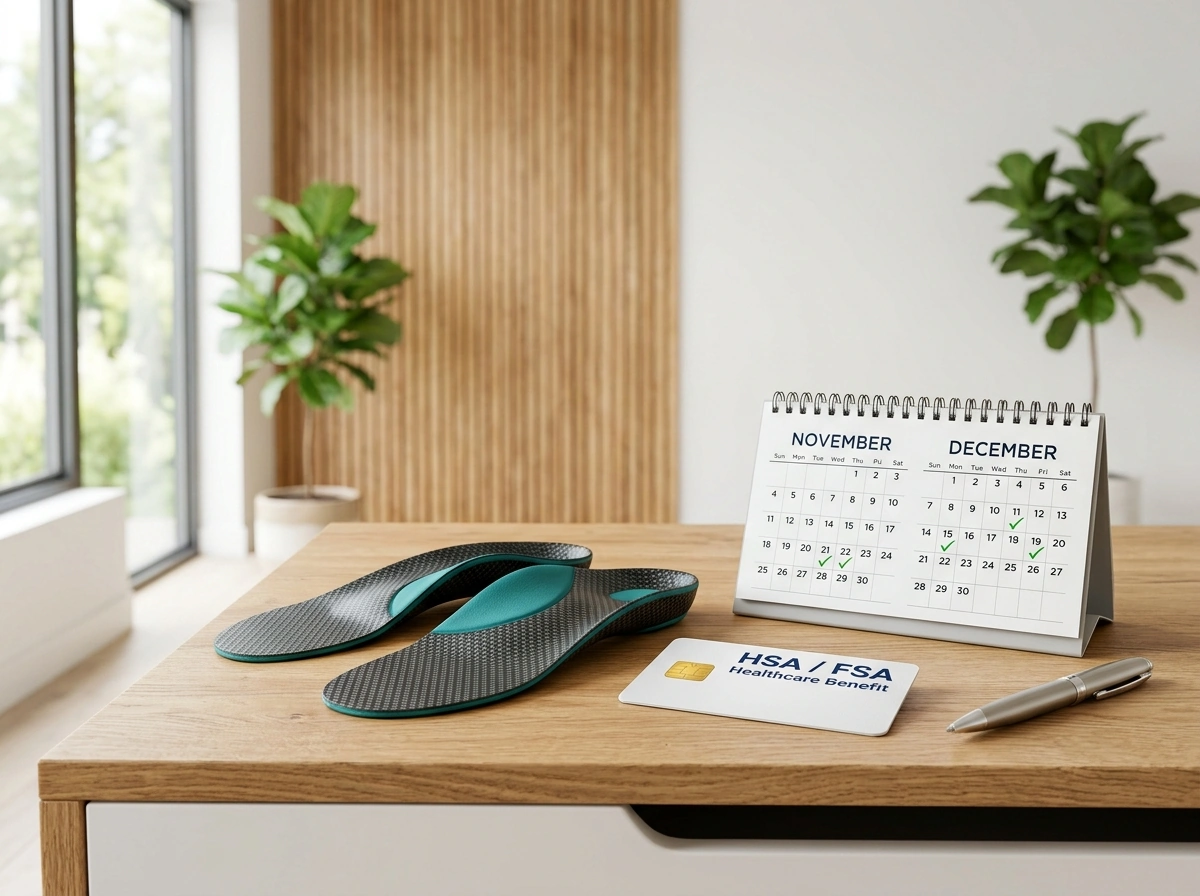
Yes—you can swipe your Flexible Spending Account (FSA) or Health Savings Account (HSA) debit card directly at checkout at Podiatry Group of Georgia in Marietta for custom prescription orthotics, permanent ingrown toenail removals, in-office digital X-rays, plantar wart treatments, and any qualified medical expenses not covered by your insurance. Furthermore, if you have already met your annual deductible, many commercial plans cover a significant portion—often 70% to 80% coinsurance (or 100% if your out-of-pocket maximum is reached) before resetting on January 1. Because custom orthotics require an initial deposit at your 3D scan and 2 to 4 weeks (up to 8 weeks in peak season) for lab fabrication before final balance pickup, scheduling in November is essential to beat the December 31 deadline.
Every November and December at my office on Johnson Ferry Road in Marietta, our team specifically checks to see whether our patients have met their annual health insurance deductible and how they can best maximize their remaining healthcare benefits before January 1st. Many patients put off treating chronic heel pain, recurring ingrown toenails, or aching arches all year—only to realize they have funds sitting in an expiring Flexible Spending Account (FSA) or an already-satisfied deductible that will reset to zero in just a few weeks.
Most people assume using year-end healthcare benefits for podiatry is as simple as booking an appointment on December 28th. In reality, maximizing your insurance coverage and pre-tax HSA/FSA funds requires understanding how clinical timelines—especially for laboratory-fabricated custom orthotics—interact with your insurance accumulator. At Podiatry Group of Georgia in East Cobb, we provide each patient with a clear timeline based on your specific insurance coverage, so you never forfeit benefits or pay unnecessary out-of-pocket costs.
Why Year-End Timing Matters: Expiring FSAs & Deductible Resets
When patients ask me how to get the lowest possible out-of-pocket cost for foot and ankle care, I always ask them to check two numbers on their health insurance portal before December 31:
1. Expiring FSA Dollars (“Use-It-or-Lose-It”): Under federal FSA regulations, employer-sponsored Flexible Spending Accounts are forfeiture accounts. For most calendar-year plans, any unspent balance above your employer's allowed carryover limit vanishes on December 31 (unless your specific employer offers a 2.5-month grace period). While Health Savings Accounts (HSA) roll over indefinitely year to year, spending either pre-tax HSA or expiring FSA dollars allows you to cover qualified medical treatments with pre-tax income.
2. Your Met Deductible & Out-of-Pocket Maximum: If you have already satisfied your annual health insurance deductible through earlier medical visits, many commercial plans cover a substantial percentage of eligible podiatric procedures—often 70% to 80% coinsurance until your out-of-pocket maximum is reached, at which point covered care is 100% covered. On January 1st, that deductible resets to zero, returning you to paying 100% out of pocket until your new deductible is met.
Earlier this year, a patient in my Marietta clinic who had been dealing with chronic foot pain waited until he met his annual health insurance deductible before moving forward with custom prescription orthotics. Because his plan included orthotics coverage and his deductible and out-of-pocket threshold had been satisfied, his insurance paid for his custom orthotics in full—he didn't have to pay a single dollar out of pocket. Depending on your specific policy, even if you still have a coinsurance balance (such as 20%) after meeting your deductible, you can swipe your HSA or FSA card to cover that remaining portion with pre-tax dollars.
How to Use Your HSA/FSA at Podiatry Group of Georgia
A common misconception is that FSA and HSA cards at a podiatrist's office are only for custom arch supports. At Podiatry Group of Georgia, you can swipe your HSA or FSA card at checkout both for your insurance cost-sharing (specialist copays, unmet deductibles, and coinsurance) and for direct medical treatments your insurance excludes:
1. Podiatrist Visits & Consultations: Specialist visit copays, deductible balances, and coinsurance for comprehensive gait exams, routine diabetic foot and nerve evaluations, youth sports injury checkups, and surgical second opinions with Dr. Delvadia.
2. In-Office Diagnostics & Imaging: Same-day weight-bearing in-office digital X-rays (for stress fractures, heel spurs, and bunions) and 1-week laboratory nail biopsies to confirm fungal vs. non-fungal nail damage without hospital facility fees.
3. Custom Orthotics & Pediatric Care:Initial 3D digital scan deposits, pickup balances, additional adult pairs for athletic or work footwear, and our 30%-off Pediatric “Grow With Me” program for growing children.
4. Treatments & In-Office Procedures: Same-day permanent ingrown toenail removal, plantar wart excision, therapeutic injections for heel pain and neuroma, and FDA-cleared Q-Clear™ laser therapy for toenail fungus (onychomycosis).
Under IRS regulations, purely cosmetic salon services are not eligible for HSA or FSA reimbursement. However, when care is prescribed by Dr. Delvadia to manage or treat an active medical condition—such as Q-Clear™ laser therapy for fungal toenails (onychomycosis), a Sterile Medical Pedicure for severe diabetic foot care, peripheral neuropathy, poor circulation, or chronic mycotic nails, or KeryFlex® nail restoration to protect and remodel a nail bed damaged by trauma or severe dystrophy—it qualifies as an eligible medical expense. While laser and procedural payments typically swipe directly with your card at checkout, some plan administrators may request a prescription or Letter of Medical Necessity (LMN), which Dr. Delvadia provides along with an itemized clinical receipt for easy reimbursement.
The Custom Orthotics Timeline: Deposit, 2–8 Week Lab Turnaround & Pickup
One detail that almost every generic online FSA checklist misses is how custom orthotics are actually billed and fabricated in a real podiatry clinic. Because prescription orthotics are custom-milled medical devices recognized under IRS Publication 502 (Medical and Dental Expenses), they go through a three-step clinical and payment workflow in our office:
Visit 1: Biomechanical Exam, 3D Scan & Initial Deposit
I perform a thorough biomechanical gait evaluation and capture a mess-free 3D digital scan of your feet. At check-out, an initial deposit is paid based on your specific insurance coverage. You can use your FSA or HSA debit card directly at our front desk for this deposit.
Lab Fabrication: 2 to 4 Weeks (Up to 8 Weeks in Peak Year-End Rush)
Your 3D scans and my biomechanical prescription are transmitted to our specialized orthotics laboratory. Standard fabrication takes 2 to 4 weeks, but depending on clinical laboratory volume and seasonal backlogs toward the end of the year, turnaround can take up to 8 weeks.
Visit 2: Orthotics Pickup, Shoe Fitting & Remaining Balance
When your custom orthotics arrive at our Marietta office, you return for a dispensing visit where I verify the fit inside your shoes and check your alignment. The remainder of your balance is collected at orthotics pickup—which can also be paid directly with your FSA or HSA card.
Why We Give Every Patient a Custom Timeline:Because the remaining balance is collected at orthotics pickup—and lab fabrication takes 2 to 4 weeks (and up to 8 weeks at year-end)—waiting until mid-December to get scanned means your orthotics won't arrive until January or February. Schedule your evaluation in November so both your deposit and pickup fall cleanly within your current benefit year.
Ordering a Second Pair & Our Pediatric “Grow With Me” Program (30% Off)
What if you already got custom orthotics earlier this year, or have used medical-grade orthotics dispensed in our office and hate swapping them back and forth between your gym sneakers and work shoes?
For adults, commercial insurance typically does not cover an additional pair in the same benefit window. However, if you were evaluated for and use medical-grade orthotics dispensed in our office, you can use your HSA or expiring FSA funds to purchase a second pair—whether that is a high-impact pair for running and tennis or a lower-profile pair tailored for dress shoes.
In East Cobb, we treat many active children and student-athletes who require biomechanical support for flat feet and foot pain. Parents often hesitate to invest in custom pediatric orthotics because kids outgrow their shoe size so quickly—and insurance rarely pays for an additional pair during active growth periods. To solve this, we offer our “Grow With Me” program, which provides a 30% discount on subsequent pairs while your child continues to grow. You can use your family HSA or FSA card directly at check-out to cover the discounted pair.