
Plantar Warts Specialist & Removal
Clear stubborn, painful warts on the soles of your feet. Led by Dr. Neha Delvadia, DPM, we offer targeted clinical treatments and chemical applications to safely eliminate the HPV infection at our Marietta office.
Quick Summary: Plantar Wart Causes & Treatment
Plantar warts (verrucae) are caused by Human Papillomavirus (HPV) entering the skin through microscopic cuts on the soles of your feet. They appear as rough, grainy lesions with characteristic black pinpoint blood vessels, often covered by thick callus. Because the virus hides in the outer skin layer beyond the immune system's reach, over-the-counter treatments are often ineffective. Dr. Neha Delvadia, DPM provides professional in-office debridement and prescription-strength Cantharidin blistering agents at our Marietta office to safely eliminate the virus and prevent it from spreading. For stubborn or mosaic warts, advanced laser therapy options are also available.
Stubborn viral infections of the sole
Plantar warts, or verrucae, are benign skin growths on the soles of the feet caused by a localized infection of the Human Papillomavirus (HPV). They are named 'plantar' because they occur on the plantar surface—the bottom—of the foot.
Unlike warts elsewhere on the body that grow outward, the pressure of standing and walking forces plantar warts inward. A thick, hard layer of skin (callus) often grows over the wart, hiding the viral core and creating a painful spot that can feel like walking on a pebble.
Because they are viral, attempting to cut or scrape them off at home is dangerous and usually causes the infection to spread or recur. Safe, sterile, and professional podiatric care with Dr. Neha Delvadia at our Marietta office is the most effective path to clearing plantar warts completely. We also offer laser therapy options.
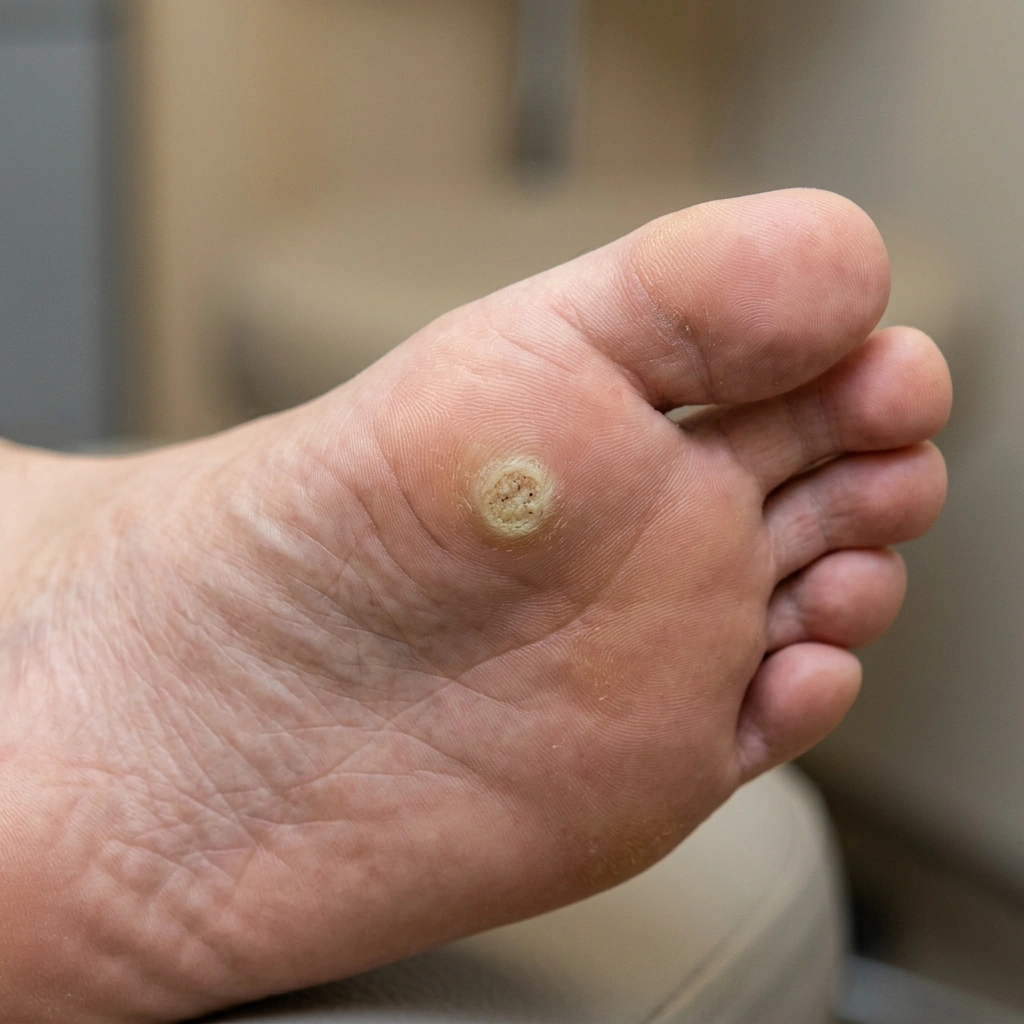
Clinical Indicators of Plantar Warts
Identify the symptoms of a plantar wart early to prevent it from spreading or causing severe walking pain.
Rough Grainy Lesion
A small, rough, fleshy growth on the sole of the foot, often resembling a small cauliflower.
Black Pinpoints
Small black dots appearing in the center of the growth, which are clotted blood vessels feeding the wart.
Interrupted Skin Lines
The natural fingerprint-like lines and ridges of your foot's skin are interrupted by the lesion.
Side-to-Side Pain
Sharp tenderness when squeezing the lesion from its sides, a key diagnostic indicator of viral warts.
Thickened Callus Layer
A hard, thickened layer of skin (callus) that forms over a well-defined spot where the wart has grown inward.
Walking Discomfort
Pain or a feeling of walking on a small pebble in your shoe, especially under the heel or ball of the foot.
Advanced Clinical Care for Foot Warts
Targeted Blistering Agents
Application of professional-strength Cantharidin compound to form a small blister beneath the wart, lifting it off the skin.
Painless Callus Debridement
Dr. Delvadia gently and painlessly pares back the overlying thick skin layers to allow clinical treatments to reach the core of the wart.
Professional Viral Control
In-office treatments ensure the virus is treated safely and cleanly, preventing it from spreading to other parts of the foot or family members.
Customized Eradication Plans
For highly stubborn or clustering mosaic warts, we design combination plans merging multiple modalities for complete clearing.
What to Expect During Your Procedure
In-office wart treatments are fast and designed to maximize medication penetration while protecting surrounding tissue.
Examine & Confirm Diagnosis
Dr. Delvadia cleans the area, pares back outer layers, and checks the skin lines to verify the lesion is a viral wart rather than a callus.
Callus Debridement
The overlying dead callus skin is painlessly trimmed down to fully expose the underlying wart tissue and its blood vessel core.
Targeted Therapy Application
A professional blistering compound or clinical-strength chemical treatment is applied directly to the exposed viral cells.
Offloading & Dressing
The treated area is bandaged and padded with custom offloading rings to ensure you can walk comfortably without pressure-induced pain.