
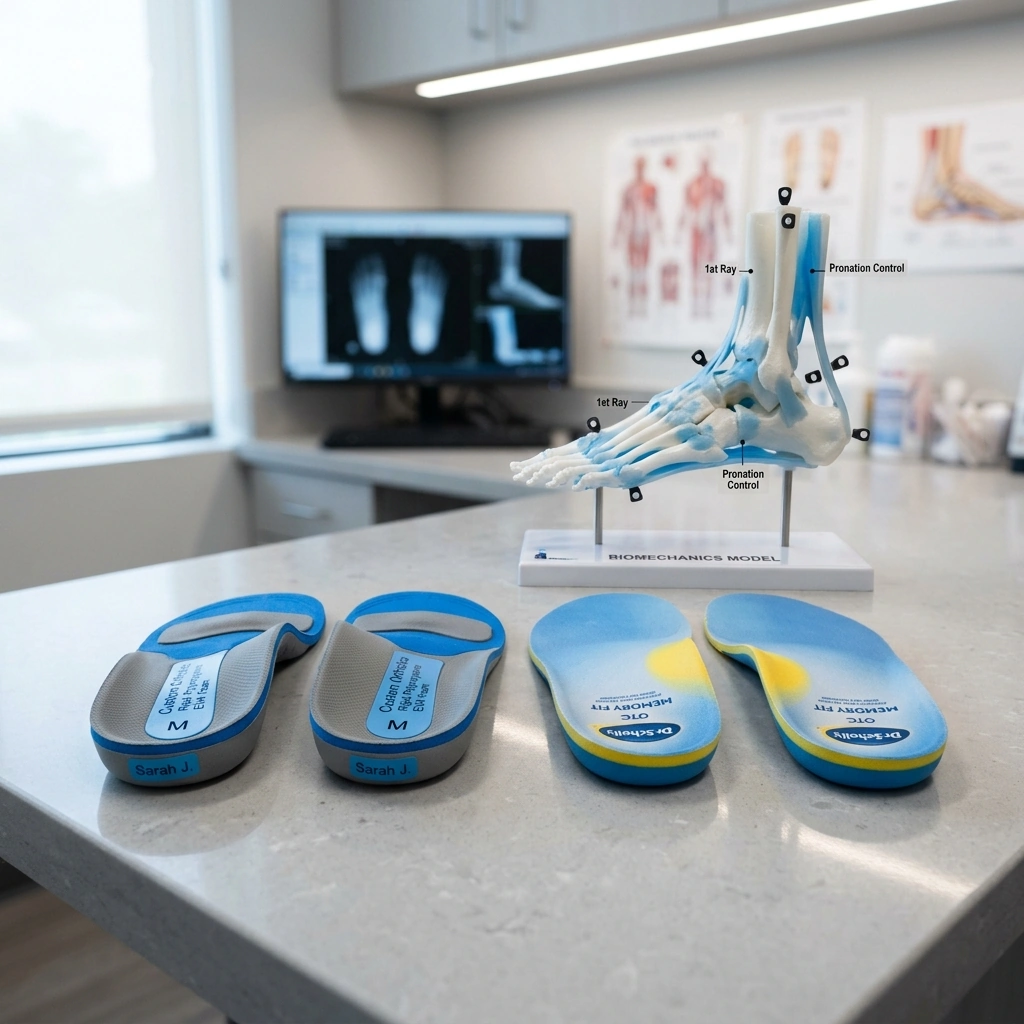
Custom orthotics are prescription medical devices engineered from 3D biomechanical impressions of your feet by an expert podiatrist in Marietta at Podiatry Group of Georgia. They correct gait mechanics, realign rearfoot alignment, and relieve severe conditions like plantar fasciitis. Over-the-counter (OTC) insoles are mass-manufactured cushions designed for generic comfort and minor shock absorption. While store-bought insoles provide temporary padding for healthy feet, custom orthotics prescribed by Dr. Delvadia provide structural correction tailored to your exact foot structure and last 3 to 5+ years.
If you suffer from heel pain, arch fatigue, or burning foot discomfort, stepping into the pharmacy shoe aisle can feel overwhelming. Wall-to-wall displays offer gel pads, memory foam inserts, and pre-packaged arch supports promising instant relief. However, next to these store-bought options lies a clinical alternative: custom prescription orthotics crafted at Podiatry Group of Georgia under the clinical care of Dr. Delvadia, a trusted podiatrist in Marietta.
Understanding the critical differences between custom orthotics and over-the-counter insoles is key to choosing the right treatment for your feet, avoiding wasted money, and preventing long-term joint strain.
What is the Main Difference Between Custom Orthotics and Store-Bought Insoles?
The primary distinction between custom orthotics and OTC insoles comes down to prescription customization, local clinical diagnosis, and biomechanical function:
- Over-the-Counter Insoles: Mass-produced based on shoe size averages. They provide padding and general arch height, but do not alter foot motion or correct structural misalignment.
- Custom Prescription Orthotics: Formed from dynamic 3D laser scans or plaster impressions taken at Podiatry Group of Georgia. They are individually engineered by Dr. Delvadia using rigid or semi-rigid medical polymers to control joint movement, redistribute pressure, and correct skeletal alignment.
Over-the-Counter Insoles: Benefits, Types, and Limitations
Store-bought insoles (commonly sold under brand names at retail pharmacies or sporting goods stores) fall into three main categories:
- Cushioning Insoles: Made from foam or gel; designed for shock absorption without arch correction.
- Trimmable Arch Inserts: Flexible plastic arches offering mild support for non-problematic feet.
- Rigid Off-the-Shelf Support: Hard plastic cups designed to limit arch collapse in standard footwear.
Because OTC insoles are symmetrical and molded to an "average" foot, they cannot account for differences between your left and right foot, leg-length discrepancies, or severe overpronation. Using a generic hard insole on an undiagnosed foot deformity can actually worsen heel pain or strain the Achilles tendon. If you are experiencing persistent foot pain, consulting an experienced podiatrist in Marietta is essential.
Why Dr. Delvadia Recommends Custom Prescription Orthotics
When you visit Dr. Delvadia at Podiatry Group of Georgia for a Custom Orthotics Consultation, our team conducts a comprehensive biomechanical gait analysis, evaluates joint range of motion, and captures precise 3D digital impressions.
Custom orthotics crafted by a specialized podiatrist in Marietta come in two primary medical classifications:
- Rigid Functional Orthotics: Constructed from carbon fiber or polypropylene to control motion in the subtalar and midtarsal joints. Ideal for severe flat feet, overpronation, and chronic tendon strain.
- Accommodative Soft Orthotics: Crafted from memory-retaining plush polymers to cushion and offload pressure points. Essential for diabetic foot ulcer prevention, fat pad atrophy, and rigid arthritic joints.
Comparison Table: Custom Orthotics vs. Over-the-Counter Insoles
| Feature | Over-the-Counter Insoles | Custom Orthotics (Podiatry Group of Georgia) |
|---|---|---|
| Customization | Generic / Mass Sized | 100% Custom 3D Laser Scan by Dr. Delvadia |
| Medical Intent | Temporary Comfort & Cushioning | Biomechanical Gait Correction |
| Durability & Lifespan | 6 – 12 Months | 3 – 5+ Years (Refurbishable) |
| Clinical Evaluation | None Required | Marietta Podiatrist Exam & Gait Scan |
| Target Conditions | Mild foot fatigue, minor soreness | Plantar fasciitis, flat feet, bunions, diabetes |
Are Custom Orthotics Worth the Cost? Clinical Evidence & Research
According to clinical studies published by the American Podiatric Medical Association (APMA) and orthopedic biomechanical journals, custom-molded functional orthotics achieve significantly higher long-term pain reduction in patients with chronic rearfoot pain compared to non-custom inserts.
By stabilizing the calcaneus (heel bone) and controlling excessive pronation, custom orthotics directly reduce mechanical strain on the plantar fascia ligament and Achilles tendon. At Podiatry Group of Georgia, Dr. Delvadia ensures every custom orthotic device is precisely tuned to prevent pain from radiating upward into the knees, hips, and lower back.