
Ingrown Toenail Specialist & Painless Removal
Get immediate, painless relief from painful ingrown toenails. Led by Dr. Neha Delvadia, DPM, we offer quick in-office resections and permanent recurrence cures under localized numbing at our Marietta office.
What Causes Ingrown Toenails & How Are They Treated?
An ingrown toenail (onychocryptosis) occurs when the nail border curves into the surrounding skin, acting as a foreign body that triggers pain, swelling, and bacterial infection. Common causes include improper nail trimming (rounding corners instead of cutting straight across), tight footwear, and inherited nail curvature. At our Marietta office, Dr. Neha Delvadia, DPM performs a painless in-office partial nail resection under local anesthesia in under 15 minutes. For chronic or recurring ingrown nails, a permanent chemical matrixectomy destroys the root matrix of the offending nail edge, preventing it from ever growing back.
What causes an ingrown toenail?
An ingrown toenail (onychocryptosis) occurs when the side or corner of the toenail curves down and grows into the surrounding soft flesh of the toe. This is most common on the big toe and acts like a foreign object, causing irritation, pain, and bacterial entry.
Common causes include cutting toenails incorrectly (curving the borders instead of cutting straight across), wearing narrow shoes that squeeze the toes, previous nail trauma, or genetic nail thickness and shape.
If left untreated, ingrown toenails quickly become infected, leading to drainage, bleeding, and severe pain. For patients with diabetes or poor circulation, a minor ingrown toenail can escalate into a serious, limb-threatening complication. Immediate podiatric treatment with Dr. Neha Delvadia is highly recommended. Learn more about our diabetic foot care services.
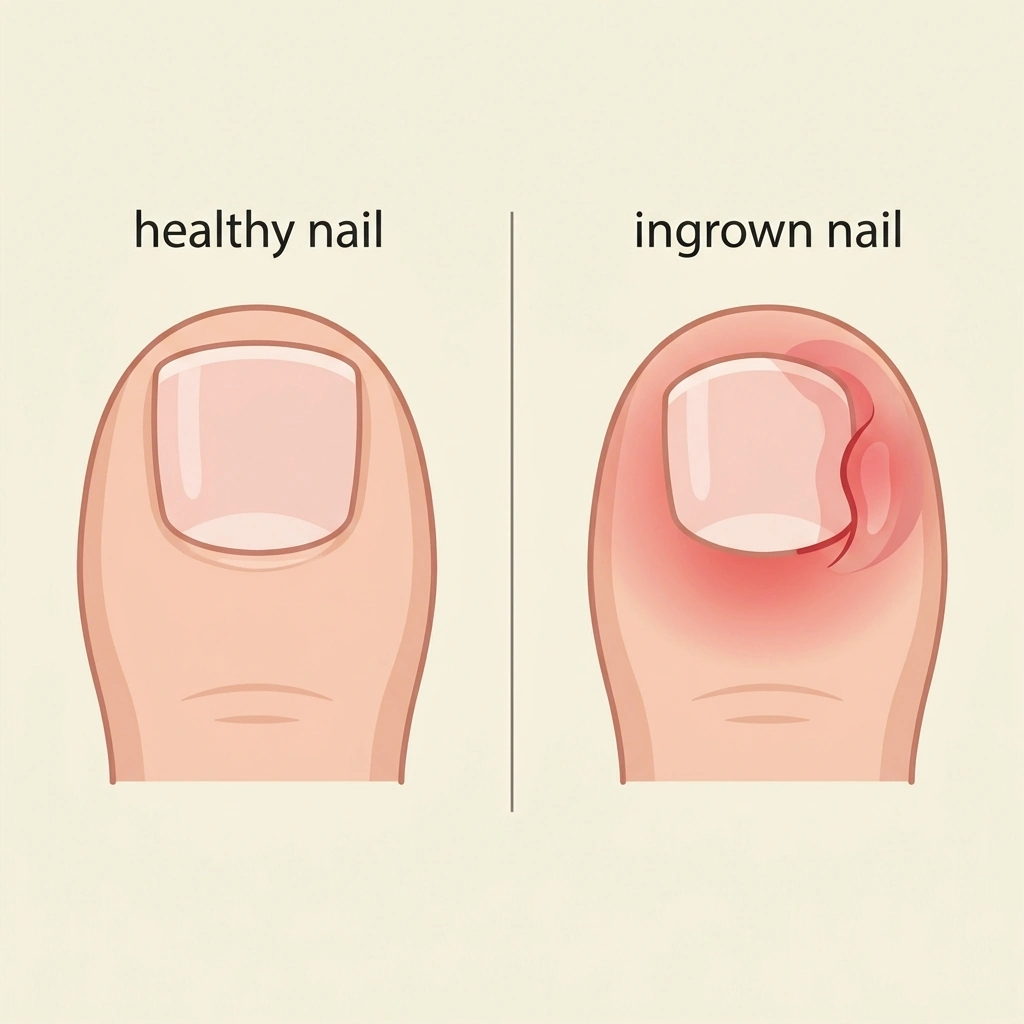
Clinical Indicators of Ingrown Borders
Recognizing the signs of an ingrown toenail early can help prevent progression to a painful, deep infection.
Nail Border Pain
Sharp tenderness or throbbing when pressure is applied to the side of the toe.
Redness & Inflammation
Visible swelling and red skin bordering the curved edge of the toenail.
Fluid & Pus Drainage
Clear fluid or yellow pus discharge, which indicates a localized infection.
Excess Skin Overgrowth
Body's healing response forming extra skin (granulation tissue) over the nail border.
Fungal Susceptibility
Broken skin borders allow secondary fungal or bacterial cells to colonize.
Warmth & Throbbing
Increased local warmth and pulsing sensations signifying active tissue inflammation.
Why Seek In-Office Clinical Treatment?
Completely Painless Resection
Local anesthetic is administered gently before the procedure, ensuring you feel absolutely no pain or discomfort.
Permanent Recurrence Cure
Applying a chemical (matrixectomy) to the nail root prevents that narrow border from ever growing back.
Under 15-Minute Session
The minor procedure is highly efficient and is completed comfortably in-office in less than 15 minutes.
Immediate Infection Relief
Removing the ingrown nail border removes the foreign body object, allowing active infections to drain and heal.
Rapid Active Recovery
Most patients experience immediate pain relief, walk out comfortably, and return to work or school the next day.
Sterile Clinical Standards
Performed in a fully sterile clinical environment by a Board Certified Podiatrist following high safety safeguards.
What to Expect During the In-Office Procedure
The procedure is performed directly in-office, taking under 15 minutes and prioritizing patient comfort at every step.
Localized Numbing Block
A local anesthetic is administered to completely numb the toe. You will feel zero discomfort during the resection.
Sterile Site Preparation
The toe is thoroughly cleaned and prepared using hospital-grade surgical prep solutions to prevent infections.
Precise Border Resection
A podiatrist gently lifts and trims away only the narrow curved border of the nail that is digging into your skin.
Root Matrixectomy & Bandage
A mild chemical is applied to destroy the root matrix of that edge (if permanent cure is chosen) and a light bandage is applied.