
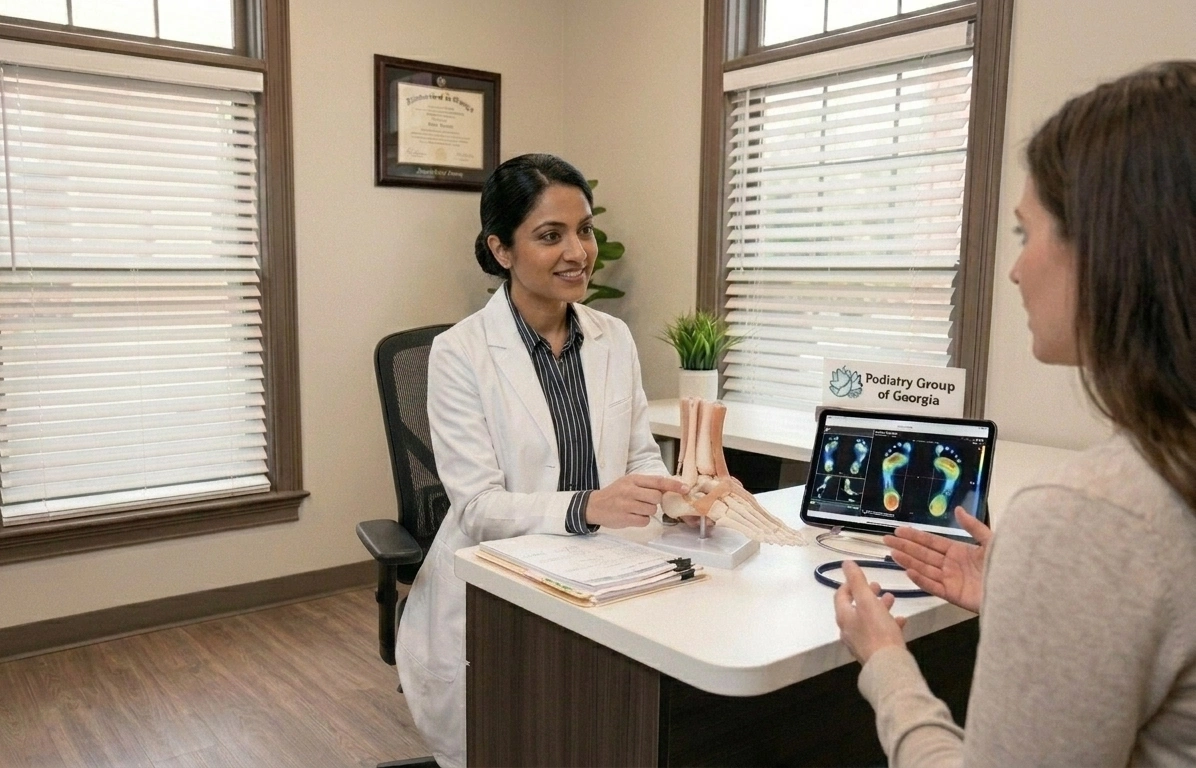
See a podiatrist (DPM) if your symptoms, pain, deformity, or injury are located strictly from the ankle down—including heel pain, plantar fasciitis, bunions, ankle sprains, stress fractures, Achilles tendonitis, ingrown nails, and diabetic foot wounds. Podiatrists specialize exclusively in foot and ankle biomechanics, conservative therapies, and reconstructive lower extremity surgery with rapid same-day triage. See an orthopedist (MD/DO) if your condition involves multiple joint systems, primary knee or hip pathology, spinal nerve pain radiating downward, or multi-bone trauma above the ankle.
Your heel is throbbing. Or maybe you rolled your ankle at a weekend soccer game and it's swollen to twice its normal size. The first question isn't "How bad is it?" — it's "Who do I even call?"
In Marietta and East Cobb, we hear this constantly. Patients assume orthopedists handle "bone problems" and podiatrists handle "foot skin stuff." That's wrong — and it costs people weeks of unnecessary waiting, hundreds in avoidable facility fees, and sometimes a worse clinical outcome.
Both are surgical and medical doctors. But their training pipelines, daily caseloads, and diagnostic toolkits are fundamentally different. Here's what actually matters when you're deciding.
The Fundamental Difference: Surgical Training & Daily Focus
Let's address the elephant in the room. A surprising number of patients (and even some primary care physicians) still believe that orthopedists are the "real surgeons" while podiatrists just trim toenails and treat calluses.
That hasn't been true for decades. According to the American College of Foot and Ankle Surgeons (ACFAS), today's podiatric surgical residency programs are rigorous 3-year hospital-based training programs where residents perform complex reconstructive procedures under direct attending supervision — the same operating rooms, the same hospitals.
- Medical Education: 4-year podiatric medical school focused exclusively on lower extremity anatomy, biomechanics, and pathology.
- Residency: 3-year Podiatric Medicine and Surgery Residency with Reconstructive Rearfoot/Ankle (PMSR/RRA) credentials.
- Daily Clinical Volume: 100% dedicated to the 26 bones, 33 joints, and 100+ muscles/ligaments of the foot and ankle.
- In-House Biomechanics: Extensive training in dynamic gait analysis, kinetic chain alignment, and custom prescription orthotic engineering.
- Medical Education: 4-year allopathic or osteopathic medical school covering general whole-body medicine.
- Residency: 5-year general orthopedic residency rotating through spines, hips, knees, shoulders, and trauma.
- Daily Clinical Volume: Often focused on total joint replacements (hips/knees) unless they complete an optional 1-year foot and ankle fellowship.
- In-House Biomechanics: Primarily surgical and anatomical; conservative orthotic casting and gait analysis are typically referred out to third-party vendors.
4 Real World Factors to Consider Before Choosing a Specialist
Most online comparison charts only list symptoms in two neat columns. But in actual medical practice here in Cobb County, four practical factors directly affect your speed of recovery, your out-of-pocket costs, and the accuracy of your diagnosis:
1. The "General Orthopedist" Trap vs. True Subspecialty
If you call a general orthopedic clinic for a complex bunion deformity or severe plantar plate tear, you might be booked with an orthopedic surgeon whose primary case log consists of hip and knee replacements. Unless they are a designated foot and ankle fellowship-trained MD, a podiatric surgeon performs exponentially more specialized reconstructive foot surgeries every single week.
2. Hospital-Owned Facility Fees vs. Independent Private Suites
This catches many patients off guard. While independent orthopedic groups exist, many orthopedic clinics across metro Atlanta are hospital-owned or hospital-affiliated (operating as "Hospital Outpatient Departments"). Visiting a hospital-owned facility can trigger a separate hospital facility fee—often $400 to $1,800+—on top of your physician copay and imaging charges. Independent healthcare price transparency reports have documented this institutional fee disparity extensively. Moreover, large multi-specialty orthopedic groups often route new patients through general Physician Assistants (PAs) first. Independent specialty practices like Podiatry Group of Georgia operate private clinical suites—you see the board-certified foot and ankle surgeon directly on your first visit, with on-site digital X-rays and zero institutional facility markups.
3. Standing Weight-Bearing Diagnostics vs. Static Resting Scans
When you visit an urgent care or general clinic with foot pain, they take X-rays while you lie on an exam table. Podiatrists utilize in-office standing (weight-bearing) digital radiography. Your foot behaves completely differently under 150+ pounds of dynamic load. Weight-bearing imaging reveals subtle subluxations, metatarsal splaying, and joint space collapse that non-weight-bearing scans miss entirely.
4. In-House Biomechanics & Custom Orthotics vs. Outsourced Referrals
Most orthopedic practices are structurally and surgically oriented. When an orthopedist evaluates chronic plantar fasciitis, arch fatigue, or tendonitis, they typically suggest generic over-the-counter insoles, prescribe anti-inflammatories, or write a referral to an outside orthotics vendor or physical therapist. In contrast, biomechanical gait analysis and functional alignment are fundamental pillars of podiatry. Podiatrists perform dynamic walking assessments, evaluate subtalar and midtarsal joint angles, and take direct 3D precision impressions to engineer custom functional prescription orthotics in-house—fixing the mechanical root cause of pain rather than just masking symptoms.
Common Presentations We Treat in Marietta
These aren't hypothetical textbook examples. They're the kinds of cases that walk through our door in East Cobb on a regular basis.
When Orthopedic Knee Workups Come Back Normal
We regularly see runners and active adults who've spent months doing physical therapy and getting knee MRIs at orthopedic sports clinics — all negative. The knee isn't the problem. A biomechanical gait analysis reveals what imaging alone can't: calcaneal eversion and subtalar joint overpronation.
Translation: with every heel strike, the arch collapses. That forces the shin bone to rotate inward, which drags the kneecap out of its groove. The fix isn't knee surgery — it's custom functional orthotics that stabilize the rearfoot. Most patients see significant improvement within 4 to 6 weeks. No scalpel required.
Acute Foot Fractures Need Same-Day Triage
Here's a pattern we see too often: someone rolls an ankle at a rec league game or steps wrong off a curb. They go to urgent care, get told to "follow up with orthopedics" — and the first available appointment is 2 to 3 weeks out. Meanwhile, they're walking on a fractured 5th metatarsal with no immobilization.
That delay matters. A non-displaced avulsion fracture (sometimes called a pseudo-Jones fracture) heals well in about 6 weeks with proper pneumatic boot immobilization and monitored weight-bearing — but only if treatment starts early. Wait too long, and you risk chronic non-union that becomes a surgical problem. At Podiatry Group of Georgia, these patients get in-office standing digital X-rays and a treatment plan the same day or next morning.
"If you have pain below the ankle, you don't need to wait in an orthopedic queue. That's our entire focus — come see us at Podiatry Group of Georgia so we can get you evaluated and out of pain right away."
— Dr. Neha Delvadia, DPM | Podiatry Group of Georgia
Decision Matrix: Should You See a Podiatrist or an Orthopedist?
| Condition / Scenario | Recommended Specialist | Why This Choice Matters |
|---|---|---|
| Heel Pain & Plantar Fasciitis | Podiatrist (DPM) | Podiatrists offer in-depth conservative protocols (gait scans, night splints, custom orthotics, regenerative injections) before considering invasive surgery. |
| Gait Abnormalities, Flat Feet & Custom Orthotics | Podiatrist (DPM) | Podiatrists perform in-office dynamic gait analysis, lower-limb kinetic chain assessments, and precision 3D scanning for custom functional orthotics. Orthopedists rarely perform biomechanical fabrication in-house. |
| Bunions & Hammertoes | Podiatric Surgeon (DPM) | Podiatric surgeons specialize in 3D corrective osteotomies and minimally invasive bunion correction to maintain joint motion. |
| Acute Ankle Sprains & Foot Fractures | Podiatrist (DPM) | Rapid same-day / 24-hour access in East Cobb prevents prolonged swelling and immobility. |
| Diabetic Foot Ulcers & Neuropathy | Podiatrist (DPM) | Podiatrists are the primary medical specialists for diabetic limb preservation, custom offloading, and wound debridement. |
| Severe Multi-Trauma / High-Impact Accidents | Orthopedic Traumatologist (MD) | Hospital-based orthopedic trauma teams coordinate acute femur, pelvis, and systemic skeletal stabilization. |
| Knee, Hip, or Spine Pain Radiating Down | Orthopedic Surgeon (MD/DO) | If radiating pain originates from lumbar radiculopathy (sciatica) or severe hip degeneration, an orthopedist evaluates the spinal column and pelvic joint. |
| Rheumatoid Arthritis Affecting Multiple Joints | Rheumatologist + Orthopedist Team | Systemic autoimmune conditions affecting hands, wrists, knees, and feet simultaneously require rheumatology-led care with orthopedic surgical coordination. |
Realistic Treatment Timelines: What to Actually Expect
One thing patients always ask: "How long until I'm back to normal?" Here are honest numbers based on clinical outcomes reported by the American Podiatric Medical Association (APMA) and what we consistently see in our Marietta practice:
- Plantar Fasciitis & Tendonitis: Conservative treatment (orthotics, targeted stretching, anti-inflammatory protocol) resolves symptoms in 4 to 6 weeks for roughly 90% of patients. No surgery needed. But — and this matters — that timeline assumes early intervention. Patients who wait 3+ months before seeking care often take twice as long to recover.
- Stress Fractures & Metatarsal Fractures: Proper immobilization in a pneumatic walking boot achieves bone union in 6 to 8 weeks. The key word is "proper" — walking on a fracture without immobilization extends healing significantly.
- Reconstructive Surgery (Bunion Correction, Tendon Repair): 6 to 12 weeks of structured recovery, starting non-weight-bearing and transitioning to guided rehabilitation. Not quick — but these procedures fix the root structural problem rather than masking it.
Walking on a compensated gait for 3 weeks while waiting for an appointment doesn't just delay healing — it creates new problems. A simple ankle sprain becomes chronic instability. A treatable stress fracture becomes a non-union. And the altered walking pattern starts straining your knee, hip, and lower back. If your pain is in your foot or ankle, get it evaluated now — not in a month.
What to Do Right Now
If you've read this far, you probably already have a foot or ankle issue on your mind. Here's a simple framework:
- Pain, swelling, or deformity at or below the ankle? Call a podiatrist first. You'll get seen faster, diagnosed more precisely with weight-bearing imaging, and treated by a specialist who does nothing but this.
- Multi-joint involvement, spinal symptoms, or high-energy trauma? An orthopedist or emergency department is the right starting point.
- Genuinely not sure? Call us at (404) 806-3731. We'll tell you honestly if you need us or if you'd be better served elsewhere. That's part of the job.