
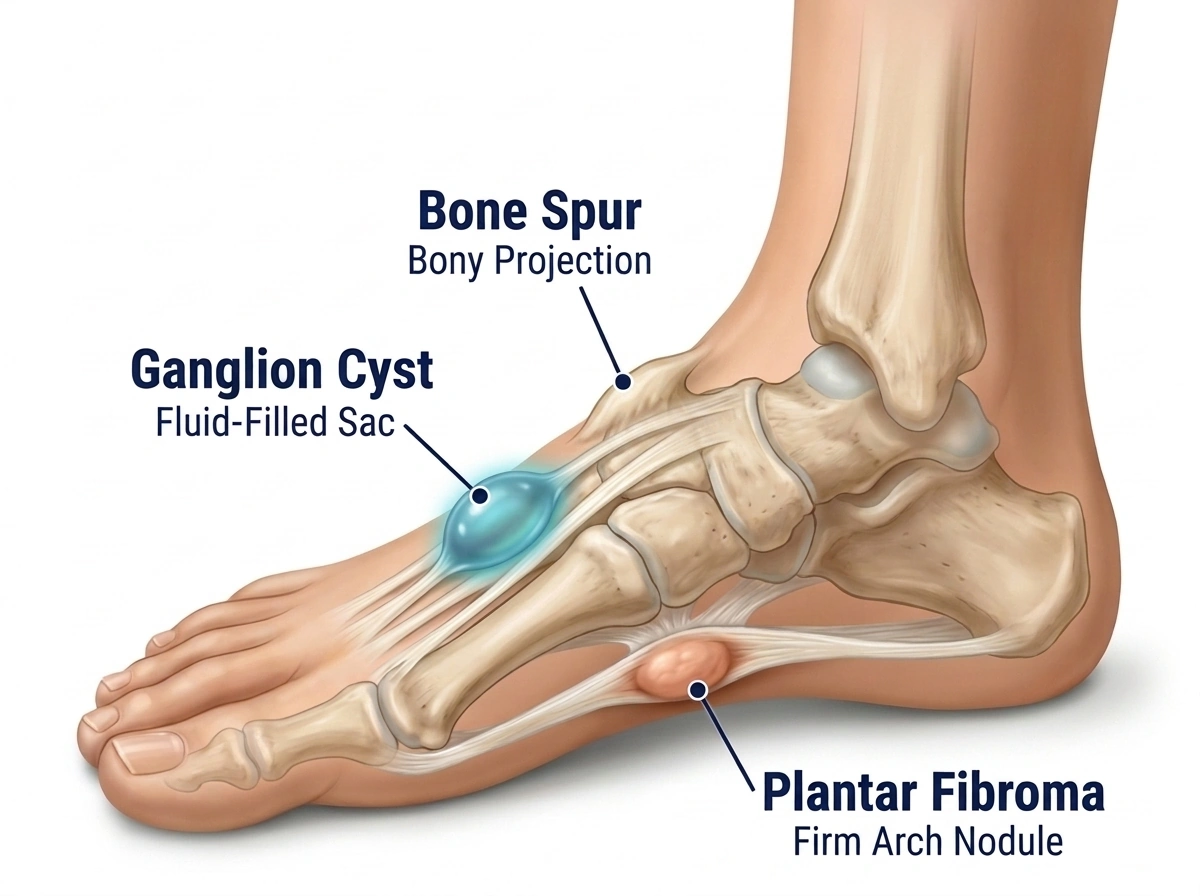
Most benign bumps on the foot fall into three distinct categories based on location: a fluid-filled ganglion cyst or bony spur on the top of the foot, a solid plantar fibroma embedded in the bottom arch, or a structural Tailor's bunion or accessory navicular bone along the side edges. Because a pressurized cyst often feels rock-hard like bone to the touch, an in-office digital X-ray is the fastest way to get a clear answer. At Podiatry Group of Georgia in Marietta, X-ray evaluation and same-day cyst aspiration take about 30 minutes in one visit—and you leave wearing the exact same shoes you arrived in.
You cannot reliably tell a soft-tissue cyst from a bone spur just by pressing on it with your fingers. Every month at Podiatry Group of Georgia on Johnson Ferry Road in Marietta, Dr. Neha Delvadia, DPM sees at least a handful of patients who walk in worried about an unexplained lump on their foot—and about half of them guess wrong about whether it is fluid or bone.
A pressurized ganglion cyst over a midfoot tendon often feels as solid as a marble of bone, while a prominent fifth-metatarsal bone on the outside edge of the foot can look and feel like a swollen fluid sac needing drainage. Because our East Cobb clinic has digital X-rays right inside the exam suite, Dr. Delvadia can separate bone from soft tissue in minutes and give you a clear plan the same day.
Top of the Foot: Why a Ganglion Cyst Feels Like a Bone Spur
When a new bump appears on the top (dorsum) of the foot where shoelaces tie, the two most common culprits look nearly identical from the outside: a ganglion cyst—a benign, mucin-filled synovial cyst arising from a joint capsule or tendon sheath (NCBI StatPearls: Ganglion Cyst)—and a dorsal bone spur (an osteophyte or tarsal boss along a midfoot joint ridge).
“I had a female patient come in concerned she had a new bump on the top of her foot. She noticed wearing certain shoes would rub against it and she was worried it was a bone spur. We were able to do in-office X-rays and confirm it as not a bone spur, but a ganglion cyst instead. She was able to get it drained the same day in the office and left ‘bump-less’.”
At our Marietta office, in-office X-ray evaluation and same-day cyst aspiration (after numbing the skin) take about 30 minutes in a single visit—and patients walk out in the exact same shoes they came in with.
Ganglion Cyst vs. Plantar Fibroma vs. Bone Spur: How Location Tells Them Apart
Before Dr. Delvadia even takes an X-ray, the exact zone where your lump sits narrows down what it is likely to be—and whether it is a soft-tissue mass or a structural bone prominence:
Soft-Tissue Lumps (Cysts & Fibromas)
- • Ganglion Cyst (Top of Foot): Smooth, tense dome over midfoot joints or extensor tendons; fluid-filled and often aspiratable in-office in ~30 minutes.
- • Plantar Fibroma (Bottom Arch): Solid, non-moving knot embedded inside the plantar fascia; cannot be drained and is treated conservatively first with custom 3D orthotics and/or targeted injections.
- • Digital Mucoid Cyst (Toe Joint): Small, shiny bead near a toe joint or nail fold; evaluated closely using Dr. Delvadia's dermatopathology training.
Bony Prominences (Spurs & Bunions)
- • Dorsal Bone Spur (Midfoot Ridge): Hard bony lip along a midfoot joint visible immediately on weight-bearing digital X-ray.
- • Tailor's Bunion (Outer Edge): Outward flare of the fifth metatarsal head behind the pinky toe—treated conservatively or surgically on our Bunions & Bunionettes page.
- • Accessory Navicular (Inner Arch): Extra congenital bone fragment above the inner arch that flares under athletic shoe friction.
“A patient came in complaining that she noticed the outer edge of her foot had a bone that seemed to be sticking out. She thought it might be a soft-tissue mass that needed to be drained. Upon X-ray evaluation it was noted that she had a Tailor's bunion. Appropriate conservative and surgical treatment was discussed with the patient.”
For a Tailor's bunion, Dr. Delvadia notes that it typically takes a few weeks to notice a bigger improvement in pain using conservative shoegear modification and protective padding—before ever needing to consider surgery.
Why Rushing Straight to Surgery Is Not Always Necessary
One misconception Dr. Delvadia frequently corrects when patients search foot lumps online is the belief that if a bump does not vanish permanently on day one, surgery is the only real fix.
“Rushing to surgery is not always necessary, as in some cases it can take multiple injections or aspirations for resolution. Ganglion cysts may shrink, disappear, or come back—it varies per patient. Some patients report needing to come in for another aspiration in a month, and some notice complete resolution with just the first aspiration.”
The same conservative-first principle applies to plantar fibromas (plantar fibromatosis) in the bottom arch. Clinical literature notes a high rate of local recurrence after surgical excision (NCBI StatPearls: Plantar Fibromatosis). For that reason, Dr. Delvadia treats plantar fibromas first with custom 3D orthotics to offload pressure and/or targeted injections—reserving outpatient foot surgery only when conservative measures fail or atypical findings warrant biopsy.
Your Step-by-Step Evaluation at Podiatry Group of Georgia
When you visit Dr. Delvadia on Johnson Ferry Road for an unexplained foot bump, here is what happens from exam to resolution:
Minutes 1–15: Physical Exam & In-Office Digital X-Rays
Dr. Delvadia evaluates the lump's location, mobility, and skin features (backed by her dermatopathology fellowship) and captures weight-bearing digital X-rays in-office to confirm whether bone—like a dorsal spur or Tailor's bunion—is involved.
Minutes 15–30: Same-Day Cyst Aspiration or Offloading Plan
If X-rays confirm a ganglion cyst, Dr. Delvadia can numb and drain it in the same ~30-minute visit—and you walk out in your own shoes. For fibromas, warts (plantar wart care), or foreign bodies, targeted offloading or removal begins right away.
Weeks 2–4: Follow-Up & Repeat Aspiration Only If Needed
Tailor's bunions typically feel noticeably better within a few weeks of wider shoes and padding. If a drained ganglion cyst partially refills, a quick repeat aspiration or injection around 1 month often resolves it without surgery.
4 Things to Do Before Your Marietta Foot Bump Evaluation
To get the clearest answers during your appointment with Dr. Neha Delvadia, DPM, follow these four steps before coming into our East Cobb office:
- Do not pop or smash the bump at home: Foot ganglion cysts often connect directly to deep tendon sheaths or joint capsules—home needle puncture risks a serious joint infection.
- Bring the exact shoes that rub against it: Sneakers, dress flats, or running shoes help Dr. Delvadia pinpoint seam-line friction and lace pressure.
- Note whether the size changes: Tell us if the lump swells after standing all day and softens overnight—a classic clue for fluid-filled cysts.
- Book promptly for red-flag symptoms: Rapid growth, redness/warmth, radiating toe tingling, or diabetes/neuropathy warrant a same-week exam.