
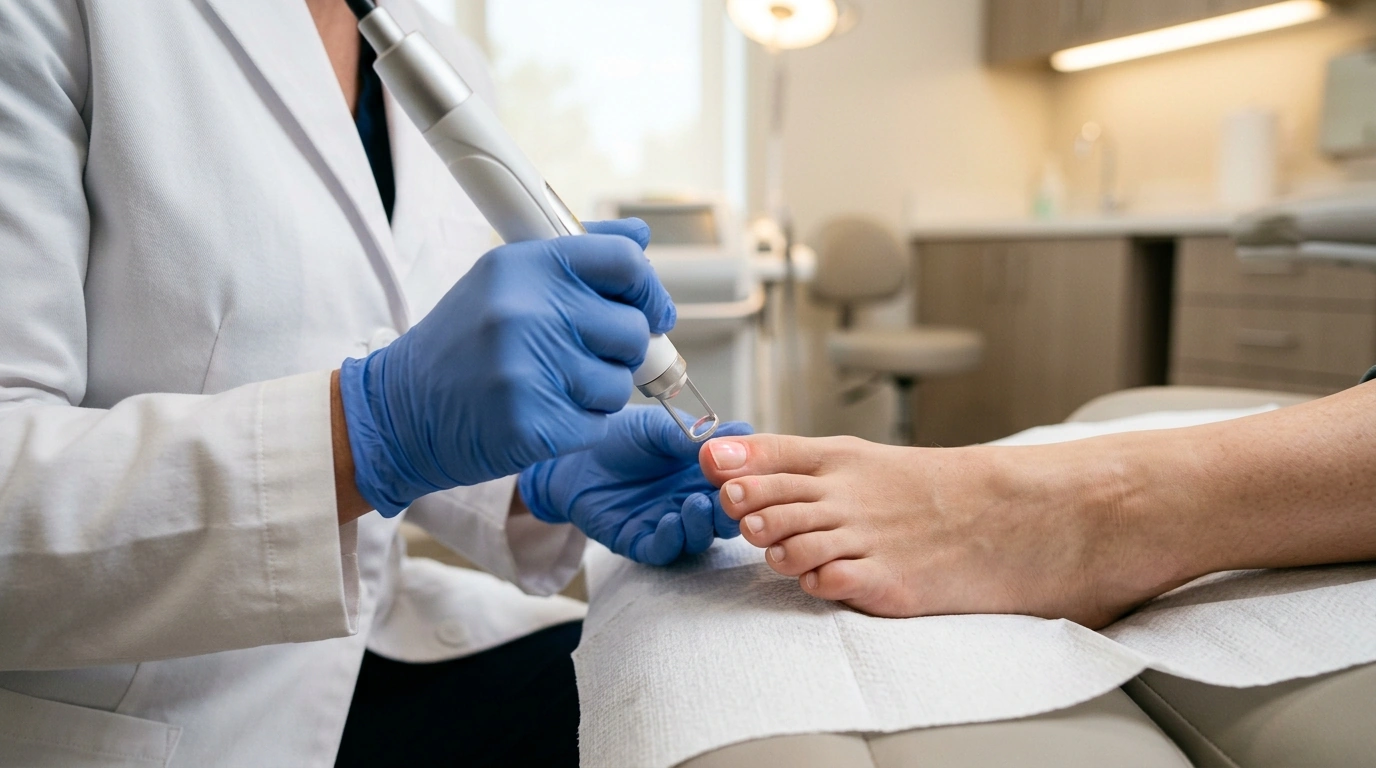
Stubborn, thickened toenails often fail to clear for two reasons: either the nail abnormality is actually non-fungal micro-trauma or nail dystrophy rather than fungus, or standard treatments leave the nail looking damaged for the 9 to 12 months it takes to grow out. At Podiatry Group of Georgia in Marietta, Dr. Neha Delvadia resolves both problems with a three-part clinical protocol: (1) an in-office exam backed by a 1-week lab nail biopsy whenever diagnosis is uncertain, (2) 1 to 2 sessions of FDA-cleared Q-Clear Q-Switch™ laser therapy (evaluated 2 months apart, versus 3 to 5 sessions with standard thermal lasers), and (3) immediate post-laser KeryFlex nail restoration so your toes look natural and healthy immediately while the new clear nail grows forward.
If you have spent months brushing over-the-counter antifungal lacquers onto a thick, yellow toenail—or even paid for laser sessions elsewhere—without seeing a millimeter of clear growth, the problem usually isn't your consistency. Either the nail was never infected with fungus in the first place, or the treatment never penetrated the nail plate while leaving you stuck staring at an unsightly nail for nearly a year.
At Podiatry Group of Georgia on Johnson Ferry Road in East Cobb, we approach thickened, discolored toenails differently. Instead of guessing at the diagnosis or selling one-size-fits-all laser packages, we combine definitive pathology lab testing, FDA-cleared Q-Clear Q-Switch™ laser therapy, and KeryFlex nail restoration so you treat the true biological cause and walk out with a natural-looking nail immediately.
Why Your “Stubborn Toenail Fungus” Might Not Be Fungus at All
In clinical dermatology and podiatry, roughly 40% to 50% of thickened, yellowed, or crumbling toenails are not caused by a fungal infection (NCBI StatPearls: Onychomycosis). Yet across Marietta, patients routinely spend hundreds of dollars on antifungal creams, oral medications, or cash-pay laser packages before anyone verifies whether fungal spores are actually present.
When a patient comes into our office with concern for toenail fungus, an in-office clinical examination helps us evaluate the nail plate and nail bed. If there is any diagnostic doubt, we perform an in-office nail biopsy. The nail biopsy sample is sent to the pathology lab just like routine bloodwork. Insurance coverage for the biopsy varies per the patient's plan, and definitive lab results arrive in about 1 week.
“I had a patient come in for ‘stubborn fungus’ who had tried countless treatments and was very dissatisfied with all his results. After taking a nail biopsy, it came back negative for fungus, and we were able to get him started on the right treatment plan. The nail started to grow clear and eventually went back to normal!”
If your nail biopsy comes back negative for dermatophytes, yeast, or mold, no antifungal pill or laser on earth would have fixed your toe—because you cannot kill an infection that isn't there. Common non-fungal culprits we identify and treat differently include:
- Repetitive Micro-Trauma (“Runner's Toe” or Tennis Toe): Every time your longest toe taps the front or top of a tight toe box on East Cobb trails or tennis courts, the nail matrix responds to the impact by producing extra-thick, yellowish-brown protective keratin and lifting slightly off the nail bed (onycholysis). Read more on our Black Toe & Nail Trauma page.
- Nail Psoriasis & Inflammatory Nail Dystrophy:Autoimmune inflammation inside the nail bed can cause deep pitting, salmon-colored “oil drop” discoloration, and chalky subungual debris that looks identical to onychomycosis to the naked eye.
- Biomechanical Toe Pressure: Structural hammertoes or hallux rigidus cause abnormal downward shoe friction on the nail plate, permanently thickening the nail until the mechanical pressure is offloaded.
Not All Laser Machines Are Equal: Q-Clear Q-Switch™ (1–2 Sessions) vs. Thermal Lasers (3–5 Sessions)
Once we confirm that your toenail truly has a fungal infection (onychomycosis), the next question patients ask is what kind of laser toenail fungus treatment in Marietta actually works—and why session counts vary so wildly from clinic to clinic.
“Not all laser machines are designed equally, and results vary. With the Q-Clear laser machine, you can start seeing results after 1 to 2 treatment sessions, while others may take 3 to 5 treatment sessions. The Q-Clear laser is designed to eliminate fungus after even just 1 treatment session. After the treatment, the nails are evaluated, and if another treatment is needed, we can do it in about 2 months at the follow-up visit.”
Why does the FDA-cleared Q-Clear Q-Switch™ laser require only 1 to 2 sessions when other clinics require 3 to 5 visits? The difference comes down to laser physics:
Q-Clear Q-Switch™ Laser (Our Marietta Clinic)
- • Typical Sessions: Engineered to eliminate fungal pathogens in 1 session (re-evaluated at 2 months; 1–2 sessions total).
- • Mechanism: Patented Unique Pulse Format (UPF) delivers high peak power in ultra-short nanosecond pulses (1064nm/532nm) to shatter fungal cell walls photomechanically.
- • Comfort & Speed: Minimal thermal heat transfer to surrounding skin or nail bed—safe for all skin tones (Fitzpatrick I–VI), no anesthesia required, and under 10 to 15 minutes for both feet.
- • Immediate Post-Care: Compatible with same-visit KeryFlex nail restoration to restore a natural aesthetic immediately.
Standard Continuous Thermal Lasers
- • Typical Sessions: Frequently sold in multi-visit packages of 3 to 5 sessions.
- • Mechanism: Long-pulse microsecond heating that gradually raises the temperature of the entire nail plate to bake fungal hyphae thermally.
- • Comfort & Heat: Energy delivery is limited by the heat accumulation and pinching sensation the patient can tolerate before the handpiece must be moved.
- • Post-Care Limits: Patients are typically instructed to leave the damaged nail unpolished for months.
In landmark clinical trials on the Light Age Q-Clear™ laser system (Kalokasidis et al., 2013), 95.4% of culture-proven patients achieved negative fungal cultures at 3 months following pre-laser nail debridement and two Q-Clear laser sessions, with over half demonstrating more than 50% visual nail clearance during follow-up. Compared to oral antifungal pills like Terbinafine (Lamisil)—which require taking a daily systemic pill for 90 days and drawing routine blood tests to monitor liver enzymes—our Q-Clear laser treatment targets the nail plate locally with virtually no thermal discomfort, avoiding systemic drug interactions and liver monitoring.
Solving the 9–12 Month Wait: Pairing Laser With KeryFlex Nail Restoration
Here is the biological truth about toenail fungus: even when the laser neutralizes the fungus on day one, existing damaged nail tissue cannot turn clear overnight.
Toenails grow at a natural biological rate of roughly 1 to 1.5 millimeters per month. Once fungal pathogens are treated at the base of the nail, a band of clear, healthy nail begins emerging from the cuticle in 2 to 3 months, and a great toenail takes 9 to 12 months to replace itself completely.
Traditionally, patients are told to simply wait out those 9 to 12 months with a thick, discolored nail—and to avoid wearing regular nail polish because it can trap moisture against exposed nail beds. For women during sandal season, swimmers at East Cobb neighborhood pools, or anyone preparing for a major family milestone, hiding your feet for a full year is deeply frustrating.
That is why we pair our Q-Clear laser protocol directly with KeryFlex Nail Restoration. Because the Q-Clear laser does not thermally scorch the nail bed, KeryFlex can be applied right after your laser treatment.
“Being female and dealing with toenail fungus can be embarrassing, especially during open-toe shoe season. I had a patient whose son was getting married later that month, and she was looking for a cosmetic option along with treating her fungus. We were able to use KeryFlex and give her a more ‘normal’ looking nail as she treated the fungus—and her toes were smiling at the wedding photos.”
Unlike salon acrylics—which are rigid, porous, and use harsh industrial primers that tear up compromised nail beds— KeryFlex is a medical-grade, biocompatible composite resin sculpted in our sterile office in about 30 minutes:
- Flexes Naturally With Your Toe: It bends with the natural biomechanics of your foot inside athletic shoes or dress heels without lifting or pinching.
- Non-Porous Protective Seal: It forms a waterproof barrier that prevents locker-room or pool moisture from getting trapped underneath while allowing you to apply topical antifungals around the cuticle.
- Paint & Polish Ready Immediately: You can paint a KeryFlex nail with regular nail polish and use acetone remover just like a natural nail. Each application lasts 6 to 8 weeks as your healthy natural nail grows forward underneath.
Your Step-by-Step Timeline at Podiatry Group of Georgia
When you schedule a nail evaluation at our Johnson Ferry Road office, here is how the clinical timeline unfolds from start to finish:
Week 1: Clinical Exam & Definitive Nail Biopsy (When in Doubt)
Dr. Delvadia begins with an in-office clinical examination to evaluate your nail plate and bed. If there is any diagnostic doubt whether trauma or psoriasis is mimicking fungus, we perform a quick nail biopsy for pathology lab analysis. Definitive results return in about 1 week.
Treatment Day: Debridement + 10-Minute Q-Clear Laser + Optional KeryFlex
We professionally thin and clean the thickened nail plate, perform the painless Q-Clear Q-Switch™ laser treatment in under 10 minutes, and—if you want immediate cosmetic restoration for open-toed shoes—sculpt your KeryFlex nail right after.
Month 2 Follow-Up: Clinical Growth Check (& 2nd Laser Session If Needed)
At about 2 months, Dr. Delvadia evaluates the new nail emerging from the cuticle base. Many mild-to-moderate infections respond after just 1 session; if a deep-seated infection needs a second Q-Clear session or a KeryFlex touch-up, we perform it at this visit.
Months 3–12: Full Clear Nail Replacement & Reinfection Prevention
To protect your investment in Georgia's humid climate, we pair your grow-out phase with shoe sanitization guidance, treatment for any surrounding athlete's foot (tinea pedis), and optional sterile medical pedicures so salon instruments never reinfect your healing nail.
3 Things to Do Before Your Marietta Nail Evaluation
To get the fastest answers during your appointment with Dr. Neha Delvadia, DPM, follow these three steps before coming into our East Cobb office:
- Do not trim your toenails short for 1 to 2 weeks before your visit: If we need to perform a nail biopsy to confirm whether fungus is present, having a small free edge of affected nail makes sampling quick and effortless.
- Arrive with bare, unpolished nails: Remove any nail polish or OTC lacquer at least 24 hours ahead of time so Dr. Delvadia can inspect the true color of the nail bed and perform same-day Q-Clear laser treatment if indicated.
- Let us know if you have an upcoming wedding, trip, or event: If you are interested in pairing your treatment with KeryFlex nail restoration, please let our team know when booking. Because KeryFlex involves precision custom sculpting, it requires a dedicated appointment and must be coordinated in advance based on schedule availability. Ask our front desk about using your HSA or FSA card for eligible treatment services.