
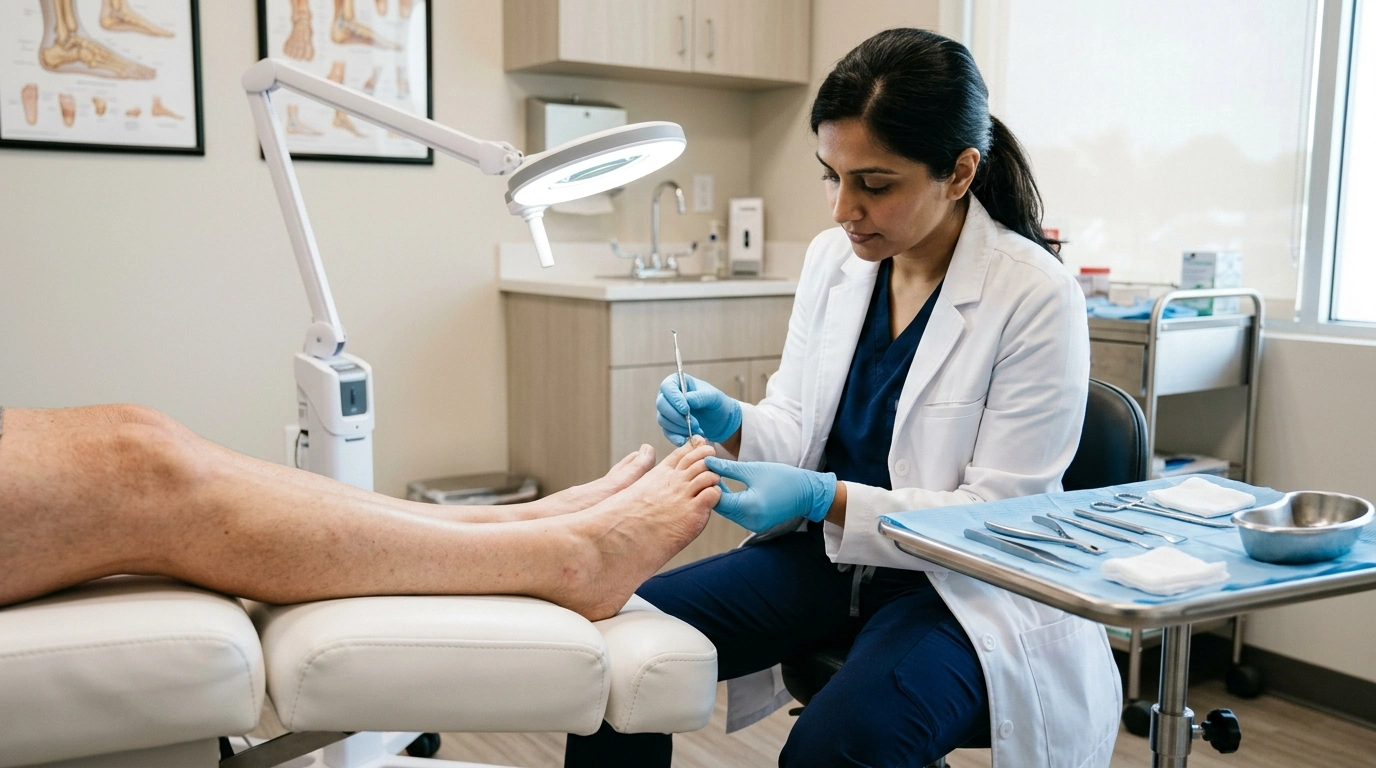
An in-office ingrown toenail procedure takes less than 30 minutes, provides instant pressure relief under gentle local anesthesia, and requires removing only a narrow 1–2 mm sliver of the nail border—never the entire nail. Most patients return to normal activities within 24 hours, and permanent chemical matrixectomy ensures the painful corner never recurs.
If you are suffering from a throbbing, swollen, or infected ingrown toenail, you do not have to live with the pain, and you do not need to dread the treatment. A minor in-office partial nail avulsion takes under 30 minutes from start to finish, is completely painless once numbed, and permanently solves the problem while preserving your natural nail appearance.
In my Marietta podiatry practice, the single most common mistake I see patients make is waiting too long before seeking care. Many individuals endure weeks or even months of excruciating pain because they are terrified of two misconceptions: the fear of having their entire toenail ripped off, and the dread of a painful numbing needle.
The Danger of “Bathroom Surgery”
When an ingrown toenail starts to hurt, it is tempting to take a pair of nail clippers, cuticle nippers, or tweezers into your bathroom and try to dig out the offending edge yourself. In the podiatry world, we call this “bathroom surgery”—and it is the fastest way to turn a minor irritation into a severe bacterial infection.
When you attempt to cut down into the corner of your nail at home, you almost never reach the true root of the problem. Instead, the clippers snap the nail edge blindly, leaving behind a jagged, razor-sharp spike called a nail spicule. As your toe flexes and presses against the inside of your shoes, that hidden nail spike acts like a barbed hook, piercing deeper into the tender lateral skin fold.
Attempting to dig out an ingrown nail with non-sterile bathroom tools introduces skin bacteria (such as Staphylococcus) directly into open wounds. This quickly leads to red, oozing infections, foul odor, and the growth of inflamed, hyper-sensitive tissue known as granulation tissue.
What Actually Happens in the Chair (Step-by-Step)
When you visit Podiatry Group of Georgia in Marietta, here is exactly what happens from the moment you sit in the chair:
We administer a targeted local anesthetic at the base of the toe. While you may feel a brief initial pinch, the toe becomes completely numb within just a few minutes. From that point forward, you will feel no pain, sharp sensations, or discomfort during the procedure.
We use precision instruments to isolate and gently lift out only the narrow 1 to 2 millimeter border of nail that is incurvated into your skin fold. Your healthy nail bed and the remaining 90%+ of your toenail remain completely undisturbed.
If you have chronic or recurrent ingrown nails, we apply a precise drop of phenol solution to the nail matrix (growth cells) in that specific corner. This permanently stops that tiny sliver from growing back. The American College of Foot and Ankle Surgeons recognizes chemical matrixectomy as the gold-standard treatment for recurrent ingrown nails, with a greater than 95% long-term success rate.
The area is rinsed with sterile saline, treated with a topical antibacterial ointment, and dressed with a clean, cushioned bandage. You are ready to walk out of the office in your regular shoes.
Recovery Timeline: Immediate Relief & 24-Hour Return
The moment that offending nail border is lifted free from the skin, the chronic throbbing pressure disappears instantly. Patients who spent weeks dreading the procedure are often surprised that the hardest part was walking through the front door.
Quick, gentle single-session procedure.
Return to work, school, and comfortable walking.
Complete localized tissue healing and recovery.
Many patients ask if they will be bedridden or forced to take time off from work. In reality, virtually all patients return to work, school, and normal daily life within 24 hours. In fact, I recently had an active local runner in Cobb County who had a partial nail avulsion performed on a Thursday afternoon and safely ran 5 miles the very next morning without any pain or complications.
How to Prevent Ingrown Toenails in the Future
While some individuals are genetically predisposed to curved (incurvated) nails, following proper foot care habits can dramatically lower your risk of developing another ingrown nail:
- Cut Toenails Straight Across: Never round or taper the corners of your toenails into an oval shape. Trimming straight across prevents sharp edges from growing into the lateral nail folds. (Read our guide on proper toenail length and trimming techniques).
- Ensure Adequate Shoe Toe Box Room: Tight, narrow, or high-heeled footwear compresses your toes together, forcing the side skin directly into the nail plate. In my experience, this is the most overlooked trigger I see in active women in their 30s and 40s who wear narrow athletic or dress shoes daily.
- Protect Feet During Sports: For young athletes playing soccer, football, or tennis in Cobb County, ensure sports cleats fit properly and are replaced as feet grow (see our youth sports injury prevention guide).
- Do Not "Round" Nails After a Pedicure: This is the pattern I see most often in patients who develop ingrown nails repeatedly. Nail technicians sometimes taper the corners for cosmetic reasons without understanding the clinical consequences. Always specifically request that your toenails be cut straight across — not curved or shaped — during any salon visit.