
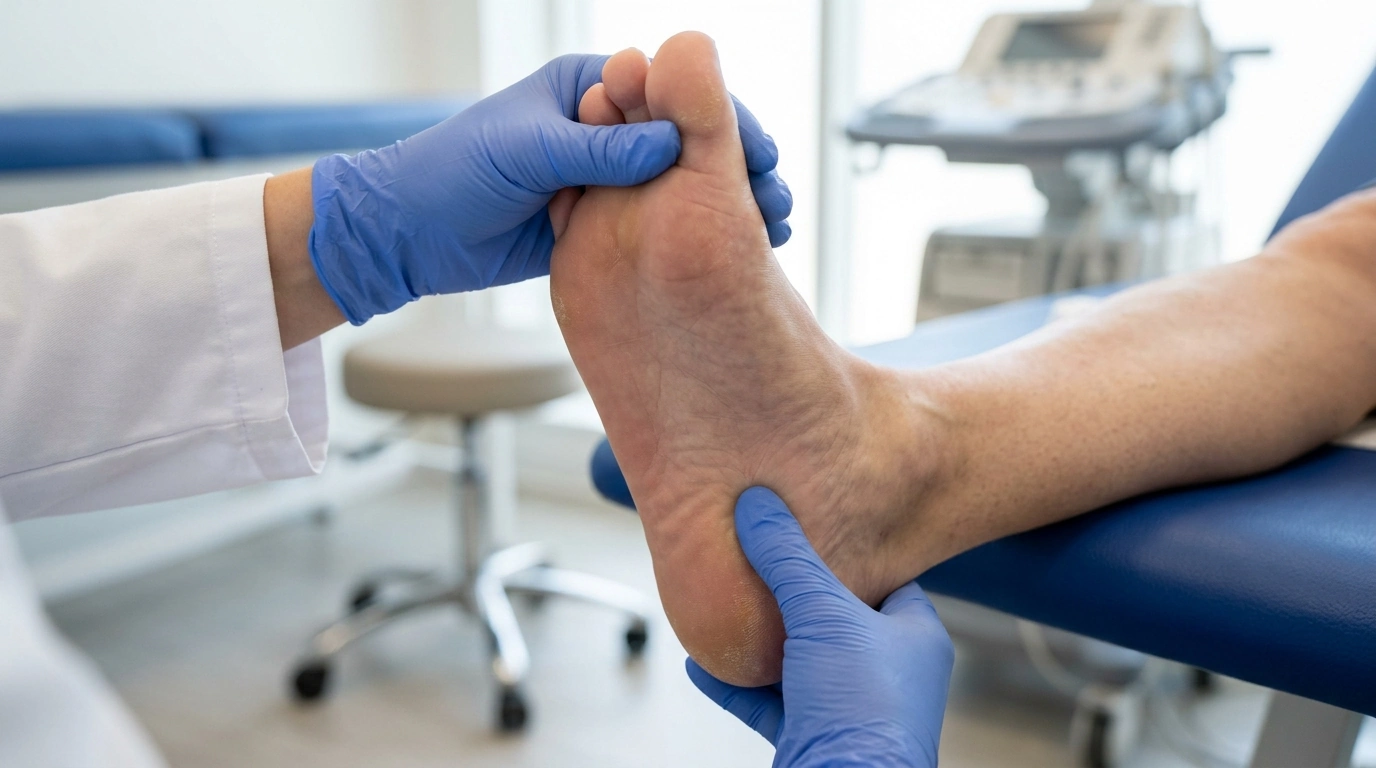
Plantar fasciitis fails to heal after months of stretching because the tissue has transitioned from acute inflammation into chronic plantar fasciosis—a degenerative state of collagen breakdown with reduced microvascular blood flow. Standard home remedies fail because they do not correct severe ankle mobility deficits (equinus), counteract the damaging force of walking barefoot inside the home on hard floors, or offload the calcaneus with biomechanically calibrated support. Over 90% to 95% of chronic heel pain cases resolve completely without surgery when targeted clinical care eliminates indoor barefoot walking, restores ankle mobility, and stabilizes the arch with custom 3D orthotics.
If you have been stretching your calves every morning, rolling your foot on a frozen water bottle, and swallowing ibuprofen with zero lasting relief, you are not alone. When a patient sits down in my Marietta office on Johnson Ferry Road and tells me, “I've been doing this for six months, but my heel hurts just as much as day one,” they are understandably exhausted and frustrated.
Many have spent hundreds of dollars on store-bought insoles, night splints, and compression sleeves, convinced that if they just push through the discomfort a little longer, their body will mend itself. But when a condition that started as brief morning stiffness evolves into an all-day ache that dictates what shoes you can wear and how many steps you can take, generic DIY routines are no longer enough. At Podiatry Group of Georgia, we uncover the exact biomechanical obstacles standing in the way of your relief.
You No Longer Have “Fasciitis” — You Have “Fasciosis”
The fundamental reason home remedies stop working after the first two months is biological: you are treating the wrong medical condition.
The medical suffix “-itis” denotes active, acute inflammation. During the initial four weeks of a heel injury, your body floods the irritated ligament with inflammatory fluid and cells. In this acute window, rest, ice packs, and non-steroidal anti-inflammatory drugs (NSAIDs) can soothe pain.
However, when micro-tearing persists without mechanical healing past six to eight weeks, active inflammation vanishes. Milestone histological studies published in the Journal of the American Podiatric Medical Association (NCBI/PubMed) demonstrate that chronic surgical specimens consistently reveal an absence of inflammatory cells. Furthermore, clinical diagnostic consensus from the American Orthopaedic Foot & Ankle Society (AOFAS) confirms that chronic recalcitrant heel pain is driven by plantar fasciosis:
- Collagen Disorganization: Healthy collagen fibers are arranged in tight, parallel bands that stretch elastically. In fasciosis, the tissue deteriorates into a disorganized, fibrotic mesh resembling dried scar tissue.
- Microvascular Starvation: The damaged ligament suffers from poor capillary perfusion, cutting off the oxygen and cellular nutrients required for natural tissue regeneration.
- Tissue Thickening & Brittleness: Rather than a supple, flexible bowstring, the plantar fascia becomes abnormally thickened, stiff, and prone to re-tearing with every step.
Applying ice and swallowing ibuprofen for chronic fasciosis is like taking cold medicine for a stress fracture. It may briefly dull nerve sensation, but it cannot repair degenerative collagen.
The “Sneaker Paradox” & The Barefoot-at-Home Trap
When evaluating patients with unresolved heel pain, I always conduct an in-depth footwear and lifestyle audit. A striking pattern appears almost every single week:
“When I see a patient with unsolved pain, I notice the patient will mention they are wearing good sneakers. However, when probing deeper, I come to discover yes, they are indeed in good shoegear when they are out of the house, but walk completely barefoot at home. Barefoot walking at home deters the ability of the heel pain to go away.”
Think of your plantar fascia like a healing papercut on your knuckle. Every time you bend your finger all the way, the wound re-opens and has to start healing from scratch.
Uncarpeted hardwood, ceramic tile, and polished concrete floors provide zero shock absorption and zero arch support. When you walk barefoot across your house, your arch completely collapses into the hard surface, exerting maximum tensile traction on the micro-repaired collagen at the bottom of your heel bone.
You might wear $160 supportive running shoes while working or running errands for eight hours, but the 2,000 to 4,000 unsupported barefoot steps you take inside your home in the morning and evening repeatedly rip apart the healing tissue. In our East Cobb office, we educate every patient on appropriate indoor recovery footwear—structured house shoes or arch-supporting recovery slides that you must step into the moment your feet swing out of bed.
Severely Reduced Ankle Mobility (The Equinus Connection)
During the hands-on physical assessment of patients suffering from persistent heel pain, one clinical finding is almost universal: their ankle range of motion is greatly reduced.
In podiatry, a restriction in upward ankle movement (dorsiflexion) is termed equinus. Your Achilles tendon and your plantar fascia are functionally linked across the calcaneus. When your calf muscles (the gastrocnemius-soleus complex) are tight, your ankle joint cannot flex upward normally as your body weight passes over your foot during a stride.
To compensate for this locked ankle joint, your foot is forced into rapid, exaggerated pronation (inward rolling). This biomechanical collapse places violent, repetitive traction onto the plantar fascia insertion during the entire push-off phase of every single step.
In our Marietta office, we frequently see patients who have faithfully performed wall calf stretches for six months with zero relief—because standard stretches cannot overcome a severe structural ankle equinus once contracture has settled into the calf-Achilles complex. Healing requires restoring true subtalar and ankle joint mobility while mechanically shielding the ligament with customized arch stabilization.
What Digital X-Rays Reveal: Bone Spurs vs. True Pathology
Whenever heel pain persists for months, performing in-office weight-bearing digital X-rays is an indispensable diagnostic step. Imaging provides immediate, objective clarity:
Traction Bone Spurs
Digital X-rays show whether a calcaneal traction spur has formed. A spur is concrete proof that your plantar fascia has been subjected to relentless, abnormal tension for months or years. The bone responds to chronic pulling by depositing calcium along the stress line.
Differential Diagnoses
Imaging rules out mimicking conditions that require radically different management, such as calcaneal stress fractures, bone cysts, or Baxter's nerve entrapment that stretching would worsen.
It is vital to recognize that the bone spur itself is almost never what hurts. The spur grows horizontally forward along the path of the ligament, not straight down into the floor. The stabbing agony you experience is the damaged, degenerated fascial band tearing at its bone anchor.
The Cortisone Myth: Why Injections Are Not a Cure
The most common misconception patients arrive with is the belief that a cortisone injection will immediately provide relief and cure them permanently.
Cortisone is a potent chemical anti-inflammatory tool. While it can temporarily mute pain signals, it does not repair degenerated collagen, it does not restore tight ankle range of motion, and it does not support a collapsing arch.
In our practice, a precision corticosteroid injection can serve as a targeted, short-term supplemental tool to provide rapid relief during severe, debilitating acute flares—making it comfortable for you to begin walking, stretching, and physical rehabilitation. However, cortisone alone is strictly a supplemental bridge, not a permanent cure. When patients rely on repeated cortisone injections without correcting their foot biomechanics, they mask the pain and return to high-impact activities on weakened tissue. Over time, multiple steroid injections dramatically increase the risk of two severe complications: permanent heel fat pad atrophy (the loss of your natural shock-absorbing heel fat) and spontaneous plantar fascia rupture.
What Actually Works: The 90% to 95% Conservative Roadmap
Here is the most encouraging fact for anyone battling stubborn heel pain: over 90% to 95% of patients heal completely with conservative treatment. Surgery is extremely rare, with only about 5% ever requiring surgical intervention.
To break the cycle of chronic plantar fasciosis, clinical treatment must simultaneously eliminate tensile overload, stimulate cellular remodeling, and establish constant arch support:
Prescription 3D Custom Functional Orthotics
Store-bought insoles provide soft foam cushioning that compresses flat under your weight. True custom 3D orthotics are rigid, biomechanically calibrated medical devices molded precisely to your feet. They control the subtalar joint, stabilize overpronation, and structurally offload the plantar fascia insertion during the entire stance phase of gait.
Continuous 24-Hour Mechanical Offloading
Healing requires that the plantar fascia is never subjected to unbuffered bodyweight impact. We establish a seamless transition protocol between outdoor supportive footwear and structured indoor support, ensuring the vulnerable insertion point remains protected across 100% of your waking hours.
Targeted In-Office Regenerative Therapies
For degenerative fasciosis where blood flow is stagnant, advanced non-invasive modalities such as FDA-cleared multiwave cold laser therapy and targeted physical rehabilitation stimulate cellular metabolism and accelerate collagen matrix remodeling without surgery or downtime.
The Healing Timeline:
It usually takes several weeks for chronic heel pain to completely resolve, but symptoms should improve significantly on a weekly basis once indoor barefoot walking is eliminated and the arch is stabilized.
When to Stop DIY Care & Get an In-Office Evaluation
If you have been stretching, resting, and buying drugstore insoles for more than four to six weeks without clear progress, continuing the same routine will only deepen tissue degeneration.
Schedule an in-office clinical evaluation immediately if you experience:
- Severe first-step heel pain that fails to loosen or improve even after walking around
- A deep, bruised bone ache at the bottom or inside margin of the heel that throbs at rest
- Burning, tingling, or electric numbness radiating into the arch or toes (signs of nerve compression)
- Compensatory pain developing in your Achilles tendon, opposite ankle, knees, or lower back
At Podiatry Group of Georgia, Dr. Neha Delvadia, DPM combines hands-on physical exams, in-office digital X-rays, and custom 3D biomechanical orthotics to diagnose the true source of your heel pain and build a personalized plan that finally resolves it for good.